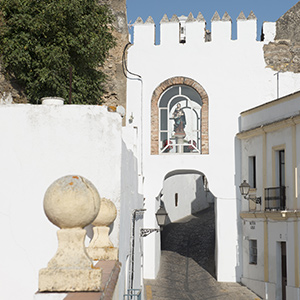


We stand before one of the blueprints for our rampart, which were expanded upon in the times of the Arcos Taifas (11th century), with these being bolstered by the Almohads (12th century) and given a com-plete overhaul less than a century ago (14th century). Its design forms a curved line between the Arcos Crag (Peñas de Arcos), which in bygone days held major defence significance and afforded protection to the southeast side of the city against possible enemy attacks.
Merely a few days ago, while I was strolling along Calle de las Jabonerías to visit one of my patients, I overheard by chance a conversation between the Mayor and a trader who voiced his discontent with the difficult access to the Castillo Square via the Old Cómpeta Gateway (of which we will talk more later on)... They were talking precisely about a new Gate that they will build at this point to facilitate the path to the highest part, so this is less burdensome for merchants carrying their goods.
”This new Gate” in the words of the Mayor “will be named Matrera” and will provide more direct and transitable access that will enable the entry of goods and supplies into our city”.
As I have been able to ascertain, thanks to a friend, a master builder, this new gate’s construction will be essential, given that the Cómpeta Gate, very close to this section of the city wall, has proven itself to be wholly unfit for this purpose. Its location next to the crag and its winding design hinders the passage of residents on Cómpeta Hill, as well as the entry of merchants and people arriving from the mountain towns, which has meant that the city has become limited in terms of access via this part of the city. For this reason, this new gate, broader and wider, will enable a more direct pathway into the higher part of Arcos.
At this point, next to the future Gate, we have the watchtower, a defensive construction dating back to the Moorish period which, as it was separated from the main wall, acted as an extension of the city wall defence, thus providing a vantage point removed from the actual city walls and offering strategic rein-forcement to the fort as a whole. The watchtower allows for defenders to remain on the lookout not only in the vicinity of the wall, but moreover along the routes the lead into the town, thereby turning it into a key protection point for Arcos.
To the side of this tower, a postern gate is located that serves as a second door in a half-hidden place alongside the Matrera Tower, allowing for inhabitants inside the walls to enter and exit without causing a fuss or even being seen. This door, although providing limited and strategic access, took on major signifi-cance at times of great urgency or when it was necessary to enable discreet entry and exit for certain individuals or goods without endangering safety in the city, or should an eventual siege take place, during which the door could be harnessed as a means of exit, enabling its defenders to flee from the besiegers’ encirclement.
The wall does not solely provide defence, it also marks the borders between urban and rural zones, be-tween the city’s safety and the risks that lurk outside its gates. This improvement project underpins the balance between protection and comfort for residents in Arcos. Onward we go, therefore, with our visit, aware of how the history of the wall that surrounds us has constantly adapted over time to our city’s new needs, while never overlooking its defensive mission.
From the old towers, let us follow the wall’s path as far as Cómpeta Gate, where our tour will draw to a close, beneath the stone lookout post that still rings out the echoes of our past…