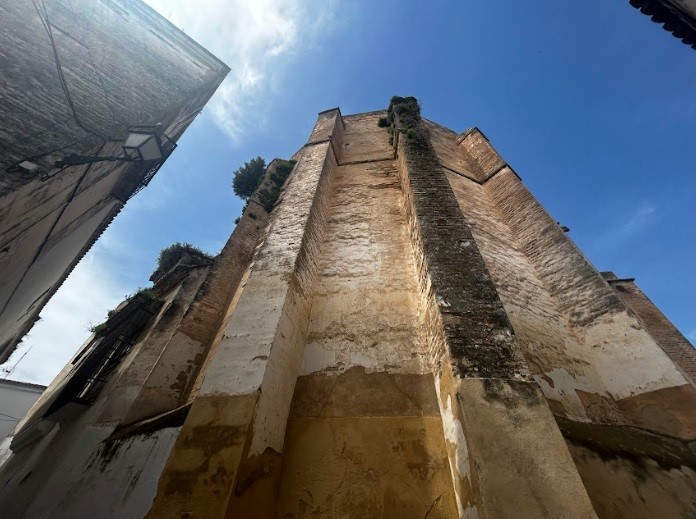


Before our eyes, we marvel at the remains of what in olden times was a vantage point or watchtower built on one of the highest parts in Arcos (next to one of the Gates forming the initial layout of the city’s wall defence), belonging to the defensive structure used in the former Moorish period named Arkus an-dalusí, when the town was an enclave of major standing in Al-Andalus (13th to 15th centuries).
The strategic significance of our city enabled it to control all of the surrounding territory, alongside trade and communication routes running through the mountains and countryside. From here, the Arcos garri-son troops not only defended the territory, moreover they oversaw the transit of troops, goods and news between the nearest towns, namely Sharis, Asbira and Madinat Ibn al-Salim (known nowadays as Xerez, Espera and Medina Sidonia, respectively). The former watchtower that can still be discerned, albeit in a state of ruin, allowed for any hostile movement to be seen from a distance, thus affording time to prime the city’s defences. In this regard, Arkus played a vital role in the territorial and border control net-work that the Muslims maintained over the region, especially with the arrival of Christian troops in the second half of the thirteenth century.
Centuries have passed since this ancient tower last performed a military purpose, yet its presence still bears witness to the borderland history of struggle and resistance between Muslims and Christians. Addi-tionally, this stop unveils another major symbolism, as here, on this very spot, I have heard the words of the clergy of Saint Mary discuss the merits of the construction of a new church in homage to Saint Peter the Apostle, along with the remains of this historic tower’s structure which it appears will be taken ad-vantage of to build the Greater Altar in the new place of worship. This mammoth task will be funded by some of the most renowned families in Arcos, amongst them the Ayllones, the Virués and the Espinosas, who have displayed their unwavering devotion and commitment to the city’s aggrandisement. This new church, raised on the remains of the former fortress, will act as a bridge between the Islamic past and the Christian present, bringing to mind that Arcos’ history is written by diverse cultures, which over the centu-ries have left their mark on these lands.
Therefore, upon gazing at the remains of this tower, we find ourselves at a genuine crossroads in time; the memory of the territory’s defence during the Moorish reign; the transformation of this space into a Christian symbol of worship; and, above all, the living image of how our city continues to serve as a meet-ing point bridging the past to the present.
Let us continue our path downwards to find the rampart on the southeast face and its gates in this border territory.