This temple, the first one designed by Christians in Arcos, was until just a few centuries ago (the thir-teenth) Muslim worshippers’ spiritual centre, as the space where it stands was built on the site of the former Arkus Great Mosque. Since my conversion, I come here to share my Christian faith with the rest of the churchgoers amongst whom I count friends, patients and relatives. Even up to our days, in the lower part of the altar walls, traces of the ancient temple remain visible through the adornments covering its walls and mihrab. The former mosque was built on one of the highest points in Arkus alongside the old Citadel, yet over the passing of time and with the arrival of Christianity, many of the buildings forming the Moorish city underwent major transformation.
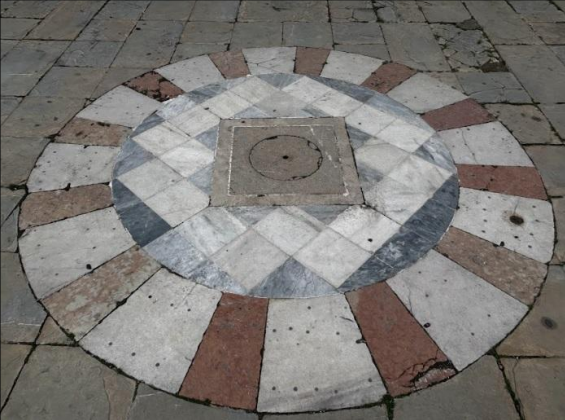
Incidentally, have you ever heard of the Magic Circle? It is located in the courtyard in front of the church’s main entrance. When I was a kid, my grandma, Basira, regaled me with countless tales of life in bygone Arcos that had been passed down to her from her own grandparents, who, as the popular tradition goes, used to say that on stifling summer nights, a huge fountain would emerge from the circle’s centre, whose healing and protective powers watched over our city’s inhabitants. Though, how did this magic circle come into being?
According to ancient writings, the Circle was built in the former Courtyard that afforded access to the Mosque, decorated with the major star constellations that can be viewed in the night sky. There was a widespread and long-standing tradition in the region of Al-Andalus of stargazing, as in the epoch of the Taïfas Kingdoms, astronomy in this part of the world was a widely encouraged scientific interest under the patronage of kings, viziers and kadis, eager to learn more and understand what enlightens us from the night’s darkness.
Let’s continue our path along Calle de los Escribanías.